

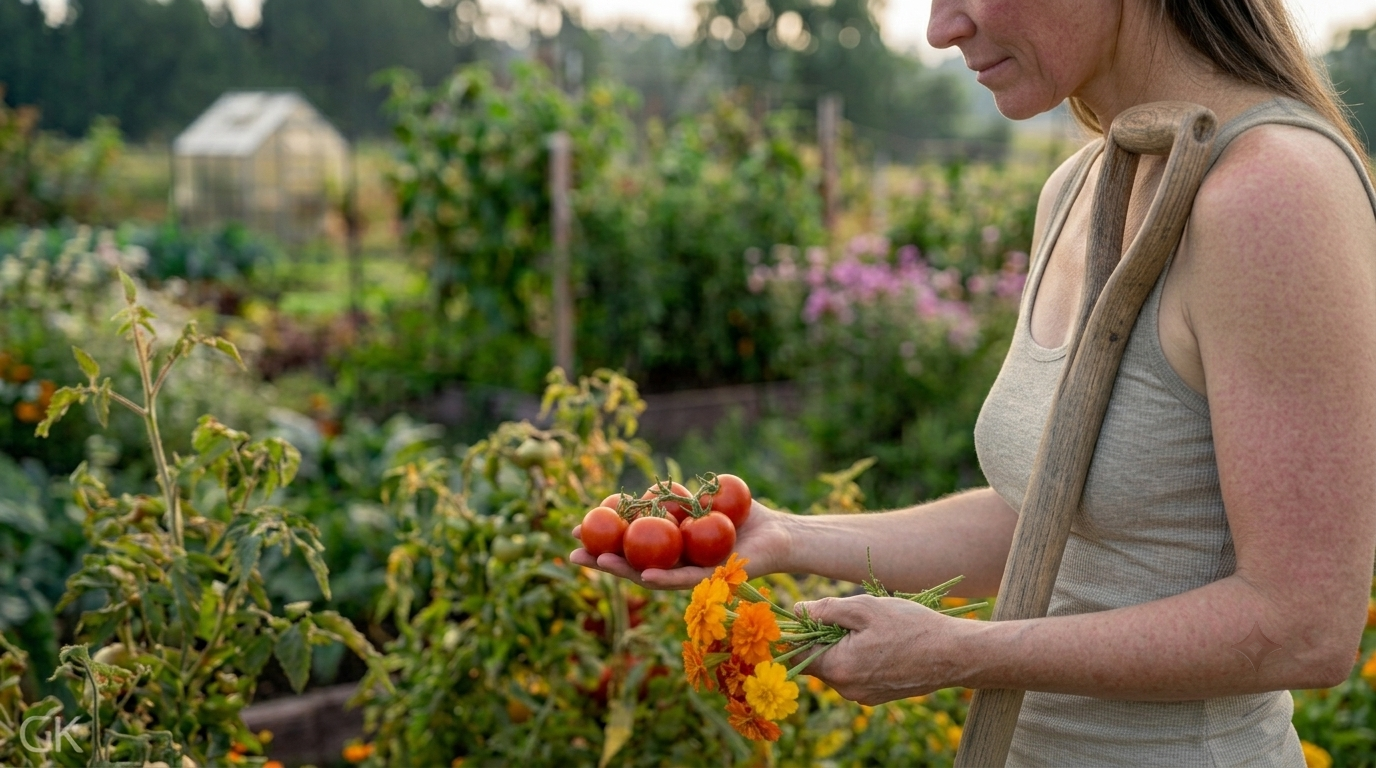

Companion Planting: What the Data Actually Says

July 9, 2026 · 9 min read
Nearly every gardener inherits a companion-planting chart at some point. Mine came from my grandmother, folded into the back of a seed tin — a grid of little plant names telling you what loves what and what to keep apart, as if the whole vegetable patch were a village with old grudges. It's a lovely thing to hold. It's also, mostly, copied folklore: the same pairings passed hand to hand for a century, rarely questioned, seldom tested.
I don't think you should have to memorize a chart like that. The better question is always why — why would two plants actually help each other? So we did something the old charts never did: we ran every pairing through our model and then went looking for the science behind the reasons. Some of the old wisdom holds up beautifully. Some of it quietly falls apart. And the data turned up a few things the folklore missed entirely. If you want the short version of how to use any of this, our companion planting guide is the place to start — but stay for the why.
Where the old wisdom holds up
Let's begin with the reassuring part, because there's more of it than sceptics expect. Our model backs planting marigolds — both French marigold and African marigold — beside crops like tomato, runner bean, cucumber, cabbage and zucchini (African marigold beside tomato is one of the model's strongest picks). That much your grandmother probably told you too. But the reason usually given — that marigolds "repel" pests — isn't really the point. The mechanism that stands up is that flowering companions feed the predators and parasitoids that eat your pests: give a hoverfly or a parasitoid wasp nectar and pollen, and it sticks around to work on the aphids and caterpillars for you[4].
The model also likes an old classic: carrot and onion together. So some of the inherited chart is genuinely worth keeping. It's the reasons we need to be honest about.
Where it doesn't
Now the gentler news. A few beloved pairings simply don't show a strong signal when we test them — and I say this with real affection, because I grew some of these on faith for years.
The famous one is basil planted to "improve the flavour" of your tomato. It's a wonderful pair on the plate, and there's no harm at all in growing them side by side — but our model finds no strong signal that one changes the other's flavour in the ground. Grow them together because you love them, not because a chart promised alchemy. I'm not going to invent a mechanism to rescue a myth.
When the myth is right — for the wrong reason
The romantic Three Sisters — sweet corn, runner bean and squash woven together — is the fascinating case, because tradition is genuinely vindicated here, just not as the mystical "companionship" it's usually sold as. Our pairwise model is actually quiet on it: score corn-with-bean or bean-with-squash two at a time and little lights up. But that's the limit of asking the question two plants at a time. Looked at as a whole system, the agronomy is clear — the three-crop polyculture out-yields the same crops grown separately, because the three root systems forage differently and together explore more soil than any one of them could alone[6]. Add the beans' nitrogen[1] and the squash's dense, soil-shading leaves[3], and it's a genuinely good system built on real mechanisms — not magic, but not myth either. It's the honest exception, and it earns its place.
The biggest misconception: it's not the smell
Here's the one I'd most like to put to rest, because it underpins half the folklore. The classic claim is that strong-smelling plants form an aromatic force field — that their scent confuses or repels pests. It's intuitive. It's also probably backwards.
The best-known scientific explanation points the other way. Many pests find their host crops largely by sight — a green leaf standing out against bare brown soil — so anything that breaks up that view, interplanting or low groundcover, can disrupt host-finding whether or not the companion smells of anything at all[3]. I want to be honest that this is a leading hypothesis, not settled law: the evidence is genuinely mixed, and the researchers themselves note the idea "was not supported by other reports." But it's the most credible story we have, and it fits the other robust finding — that flowering companions feed the pests' natural predators[4].
So the punchline is: it's groundcover and predators, not perfume. That's exactly why our model scores things like predator-attraction and canopy-and-ground structure — and why it has no "scent" signal at all. If you want to see that reasoning applied plant by plant, that's what Kinship Core is built to do.
What the data found that folklore missed
This is my favourite part, because it's where the model earns its keep — turning up sound pairings the old charts never listed. Three themes stood out. (As always: the pairing is what our model suggests; the mechanism is what the science supports.)
Living-mulch legumes. Undersow a crop with a low legume like crimson clover or hairy vetch. Legumes pull nitrogen out of the air and fix it in root nodules thanks to Rhizobium bacteria, feeding the soil around them[1] — and the low green cover breaks up the bare soil that pests use to find their targets[3].
Low salad and brassica groundcover. Quick, low growers like garden cress, mustard greens and rocket carpet the bare earth between plants[3], and some can act as trap crops — luring pests onto themselves and away from the main crop[5].
Predator-feeding herbs. Let a few herbs like dill, chervil and lemon balm flower rather than cutting them all back. Those small open flowers are exactly what hoverflies and parasitoid wasps need, and a fed predator is a working predator[4].
What to actually avoid
The chart's list of enemies deserves the same scrutiny — and here at least one warning is real and well-understood. Walnut and pecan trees release a compound called juglone that inhibits or outright kills many plants growing nearby[2]. If you have one of those in the garden, take the "keep away" advice seriously. Our model also flags fennel and sunflower as poor neighbours — allelopathy, plants chemically suppressing their competitors, is a genuine phenomenon[2], and these two are worth giving their own space.
There's also a traditional caution the model echoes without me being able to prove the cause: keeping the alliums — garlic, onion, leek, chives — away from legumes like pea and runner bean. This is old lore, and our model flags the same pairing, so I'll pass it along as a sensible caution. But I won't dress it up: the mechanism here is uncertain, and I'd rather tell you "tradition and our model both frown on it" than invent a reason I can't stand behind.
At a glance
The whole article boiled down to something you can screenshot — the honest, evidence-graded version of a companion chart:
Worth doing — and the real reason:
Marigolds (French or African) beside tomato, beans, cucumber, cabbage or zucchini — the flowers feed pest-eating predators[4].
Let dill, chervil and lemon balm flower — same reason: nectar for hoverflies and parasitoid wasps[4].
Undersow crimson clover or hairy vetch — nitrogen[1] plus soil-covering groundcover[3].
Low greens — garden cress, mustard greens, rocket — cover bare soil[3] and can bait pests away[5].
The Three Sisters as a whole system — out-yields the same crops grown apart[6].
Fine to grow together — just not for the magic:
Give room, or keep apart:
Fennel and sunflower — allelopathic; give them their own space.
Alliums (garlic, onion, leek, chives) away from legumes (pea, runner bean) — tradition and our model agree, though the mechanism is unproven.
The point
If there's one habit I'd love you to take from all this, it's the one that turns a chart into understanding: ask what the actual mechanism is, and let folklore come last. That's exactly how Kinship Core thinks about every plant — mechanism first, tradition only when it earns it. Try it on your own beds, play with pairings in Mix & Match, and browse the catalog to see the reasoning behind each plant. Your grandmother's tin was a good start. The why is where it gets interesting.
— Pernille
References
New Mexico State University Extension, Guide A-129, "Nitrogen Fixation by Legumes." https://pubs.nmsu.edu/_a/A129/
Iowa State University Extension, Yard and Garden (2023), "What plants are sensitive to juglone produced by black walnuts?" https://yardandgarden.extension.iastate.edu/faq/what-plants-are-sensitive-juglone-produced-black-walnuts
Ben-Issa R., Gomez L. & Gautier H. (2017), "Companion Plants for Aphid Pest Management," Insects 8(4):112. https://pmc.ncbi.nlm.nih.gov/articles/PMC5746795/
Chen Y., Mao J., Reynolds O.L., Chen W., He W., You M. & Gurr G.M. (2020), "Alyssum (Lobularia maritima) selectively attracts and enhances the performance of Cotesia vestalis, a parasitoid of Plutella xylostella," Scientific Reports 10:6447. https://pmc.ncbi.nlm.nih.gov/articles/PMC7160144/
Sarkar S.C. et al. (2018), "Application of Trap Cropping as Companion Plants for the Management of Agricultural Pests: A Review," Insects 9(4):128. https://pmc.ncbi.nlm.nih.gov/articles/PMC6316212/
Zhang C., Postma J.A., York L.M. & Lynch J.P. (2014), "Root foraging elicits niche complementarity-dependent yield advantage in the ancient 'three sisters' (maize/bean/squash) polyculture," Annals of Botany 114(8):1719–1733. https://pmc.ncbi.nlm.nih.gov/articles/PMC4416130/
About the author
Pernille has spent almost her entire adult life working in gardens, both personally in her own gardens, as well as professionally. She has worked at Arley Hall & Gardens, at Systrarna Lindskogs in the Swedish riviera of Österlen and spends most of her waking hours planning gardens, counting seeds and thinking 3 seasons ahead (at least). She is also the founder and creator of Garden Kinship.
Continue reading
Your First Vegetable Garden: Start Smaller Than You Think
The most common way a first garden fails is being too big. Here is how to plant less, grow more, and actually enjoy your first season.
Pernille Roos · Jul 14, 2026
It's Not Too Late to Plant: Fast Crops You Can Still Sow Right Now
Missed the spring sowing window? You haven't missed the season. Here are the fast crops you can still grow — and how to stretch the weeks you have left.
Pernille Roos · Jul 8, 2026
Meet Kindred Core: Your Garden's Matchmaker
Finding the right plant neighbours used to take years of trial and error. Kindred Core changes that — here's how it works.
Pernille Roos · Jun 17, 2026