

Cold, Wet Summer: What Stalls, What Rots, and What's Having Its Best Week

July 22, 2026 · 20 min read
There is a particular kind of northern European summer week that arrives without warning and settles in. Fourteen degrees at noon. Rain that never quite commits to being a downpour and never quite stops. Mornings that are still wet at eleven. The forecast offers you the same grey block for the next ten days, and the garden — which was doing rather well — stops.
It feels like a disaster and mostly it is not one. Almost everything you are looking at is paused rather than dying, and a fortnight of this does far less lasting harm than a fortnight of drought. But it isn't nothing either. Three things are genuinely rotting while you read this, one creature is having the best week of its year, and the single most damaging thing you can do in the next few days is the thing that will feel most productive.
What follows is organised the way you'll actually encounter it: by what you're seeing. Cold wet weather is a different animal from warm wet weather, and a lot of the advice in circulation quietly assumes the warm version.
It's the best week of the year to be a slug
Start here, because it's the effect you've already noticed and because it's genuinely the dominant one in most gardens.
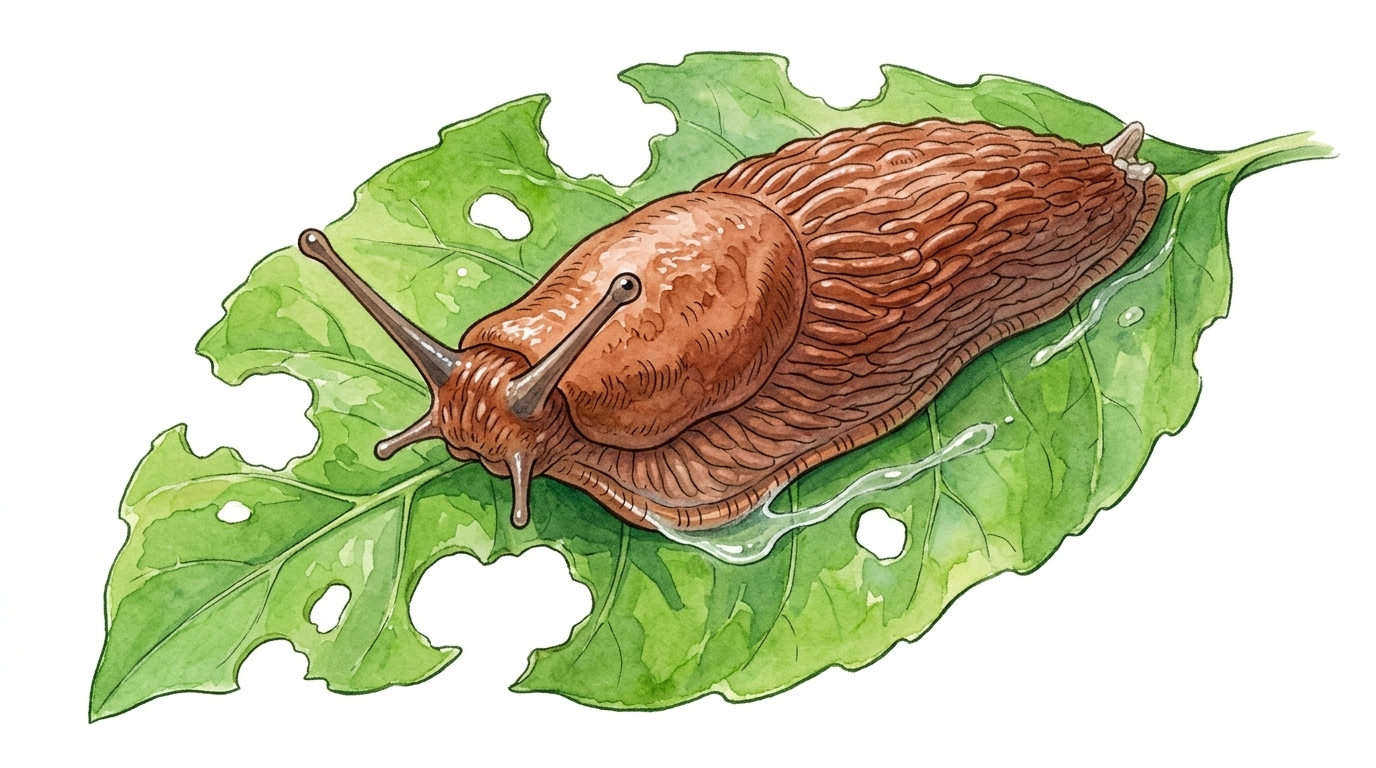
Slugs are active and reproducing between roughly 4 and 21°C, with an optimum around 16°C, and they need soil moisture above about 25% to move freely. Egg-laying peaks at around 18°C in moist soil. Read those numbers back against a cold wet July — twelve to eighteen degrees, saturated ground, damp all day — and you'll see the problem. This isn't weather slugs are tolerating. It's very close to the exact conditions the species is optimised for.
Which means the instinctive consolation — at least the cold will slow them down — is wrong by a wide margin. The temperature at which slugs go dormant is about 4°C. Nothing in a summer cold spell comes near it. If anything, the warm dry weeks you had before this were the ones holding them back.
One piece of nuance that's worth having: slugs prefer soil at around 125% of field capacity, which is wetter than you'd guess, but under genuinely abnormal saturation their movement becomes erratic and their aggregations break up. Standing water isn't their ideal either. It's the damp — not the flood — that suits them.
This is a good window to apply nematodes (Phasmarhabditis hermaphrodita), and better than most weeks you'll get. They work in soil between about 5 and 20°C, which this weather sits comfortably inside, and the soil is already moist, which saves you the watering-in that usually limits their success.
But there's a condition that most advice skips. Nematodes need water films to move through and oxygen to survive. Moist, well-drained, uncompacted soil is what they want. Saturated or compacted soil is worse for them than dry soil, because they suffocate. So apply as the surface starts to drain rather than into standing water, and keep the bed damp for the following weeks. They also don't touch snails, which rarely spend enough time in contact with soil to pick them up — if what's eating your lettuce is snails, this isn't your tool.
This is not a blight reprieve
Here's the belief this article most wants to take away from you, because it's comfortable, widespread, and can cost you a crop.
The current risk model for late blight in Britain is the Hutton Criteria: a high-risk period is two consecutive days with a minimum temperature of at least 10°C and at least six hours of relative humidity at or above 90%. Read quickly, that sounds like cold weather is safe weather. Ten degrees is a threshold, this week is chilly, therefore no blight.
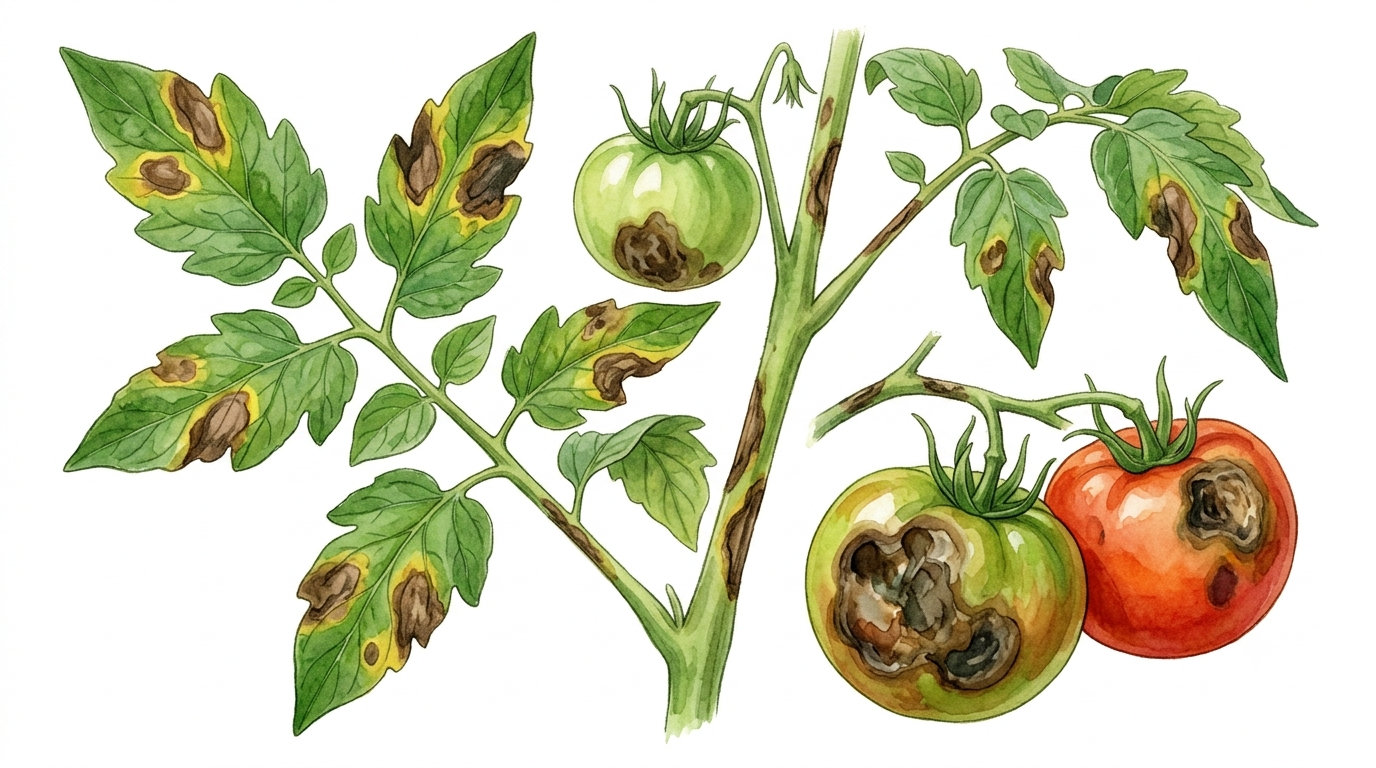
Look at the actual numbers and that reading falls apart. The UK's mean daily minimum in July is 11°C. A night that feels genuinely cold for midsummer in Britain, Ireland or the Netherlands is somewhere around 9 to 13°C — straddling the threshold, not sitting safely beneath it. A miserable 14°C day following a 10°C night, with the leaves wet since dawn, meets the criteria comfortably. You are not below the line. You are balanced on it.
The biology points the same way, and this is the part that should settle it. Phytophthora infestans has two routes into a leaf. It can germinate directly by germ tube, which it prefers at 20 to 25°C. Or sporangia sitting in free water can release swimming zoospores — and that route has an optimum of 10 to 15°C. Above about 24°C, no zoospores form at all. The cool wet route isn't the weak version of blight weather. It's the more infective one, and it's precisely why blight is a north-west European problem rather than a Mediterranean one. Teagasc puts it without hedging: the typical mild, damp Irish summer is ideal for the disease.
So the honest summary is that what suppresses blight is dry, not cold. If you grow potatoes or outdoor tomatoes, this is a week to be checking rather than relaxing. If you find something, the identification details and the day-you-see-it actions are in the late blight guide — the difference between losing a crop and saving most of it is usually whether you caught it on the first morning or the fourth.
Stay off the soil — and the dangerous day isn't the one you think
Everything else in this article resolves itself when the weather turns. This one doesn't, which is why it gets its own section despite being a single instruction.
Working or walking on wet soil compresses the pore space that roots, water and air move through. Fine-textured soils — silty clays and clays — are far more vulnerable than loams and sands. Damage in the top 20cm is recoverable over a season or two through organic matter, root action and freeze-thaw. Below that, it lasts years. You'll see confident figures quoted for how long garden-scale foot traffic takes to recover; there isn't a published one, and anyone giving you a specific number of years is guessing.
The part worth knowing is the timing, because it's the opposite of intuitive. Moist soil compacts worse than saturated soil. When soil is completely waterlogged the macropores are full of water, which doesn't compress. When it's merely moist, there's enough water to lubricate the particles and enough air space for them to be squeezed into. The most destructive moment isn't the day of the downpour, when the bed obviously looks unwalkable and you stay off it. It's two or three days later, when the surface has dried enough to look fine and you go out to catch up on everything.
Boards if you have them, permanent paths if you're planning ahead, and otherwise patience. Very little in a vegetable bed genuinely can't wait four days.
What's stalled, and isn't dead
Three separate things stop in cold weather, and all three get read as a plant failing.
Ripening
Tomato colour comes from lycopene, and lycopene synthesis is a temperature-limited step: optimal between about 16 and 26°C, strongly inhibited below 12°C, and shut down again above about 32°C. That's why a cold August produces so many stubbornly green trusses.
Be careful with how far to take that, though, because the usual telling overstates it. Between 10 and 16°C ripening slows — it does not stop. And what specifically fails below 12°C is the colour, not the whole process, which is why cool-summer tomatoes tend to go blotchy and orange rather than staying green indefinitely. The fruit softens and matures while never getting properly red.
The point at which it becomes irreversible is a genuine threshold and it takes time to reach: sustained exposure below 10°C for more than two weeks, or below 5°C for six to eight days, causes chilling injury, after which the fruit won't ripen properly even once the warmth returns. A ten-day cool spell is not that. (Fair warning on provenance: these are postharvest storage figures applied to fruit still on the plant. It's a standard and physiologically sound transfer, but it isn't itself a field study.)
What follows from this is a real action rather than a consolation. Picking at breaker stage — the first blush of colour — and ripening indoors at 18 to 24°C is actively better than leaving the fruit outside in a cold spell, because indoors you're supplying the temperature range that lycopene synthesis needs and a 13°C garden simply cannot.
Fruit set
Below roughly 13°C at night, tomato fruit set fails and flowers drop. More precisely: pollen viability falls away below 12°C, and below 10°C the pollen's ability to stick to the stigma, germinate and grow a tube is damaged directly.
The detail that makes this worth knowing is the lag. The temperature-sensitive stage happens roughly seven to thirteen days before the flower opens, while the pollen is still developing. Add the time from a failed pollination to a visibly empty node and you get a gap in the truss appearing something like two to three weeks after the cold. The hole you find in August was decided in July.
There is nothing to do about it now. It's worth knowing anyway, because otherwise you'll spend a fortnight in late summer diagnosing a feeding problem that doesn't exist.
Courgette and squash fruitlets
The symptom: a young fruit swells at the stalk end while the flower end shrivels, browns and starts to rot, and the whole thing drops off. On a courgette this can happen to fruit after fruit through a wet spell, and the same goes for pumpkin, summer squash and cucumber.
This is failed pollination, not disease, and it gets called blossom end rot constantly. The tell is timing. Pollination failure rots the fruitlet fast, right as the flower fades, while it's still small. Genuine blossom end rot shows up later, on fruit that has already put on real size — and on garden courgettes it's uncommon to begin with. If your fruitlets are dying young and the flower end is going first, stop looking for a calcium problem.
The cause is worth getting right too, because "bees stop flying in the cold" is too blunt for northern Europe. Honeybees do largely stop sustained foraging somewhere around 10 to 13°C. But bumblebees forage down to about 6°C, work in dull drizzly conditions, and are the main courgette pollinator across most of this region. A 14°C week doesn't shut pollination down.
What does the damage is rain landing in the flower's one open morning. Cucurbit flowers open for a single morning and close by early afternoon. A run of wet mornings means a run of flowers that never get visited, and that's your line of aborted fruitlets.
Hand pollination works — strip the petals off a male flower and press the anther against the stigma of a female — and it's worth doing. Don't expect it to rescue everything, though. In dull weather the plant often opens a female with no male available the same day, and wet pollen clumps and transfers badly. Late morning, under cover if you can get the plant under anything, and accept a partial result.
What's actually rotting
The genuine disease pressure in this weather, roughly in the order you're likely to meet it.
Grey mould (Botrytis cinerea) is the one to expect. The thing to understand about it is that it's a wetness-duration disease rather than a temperature disease: infection needs about six continuous hours of leaf wetness, or six hours above 90% humidity. Its actual temperature optimum is 22 to 25°C — warmer than this week — but it stays perfectly active well below that, and a cold wet spell hands it twenty-four hours a day of the one thing it genuinely requires.
It gets in through ageing flower petals, dying leaves, wounds and pruning cuts, which tells you exactly what to do: clear spent flowers and yellowing lower leaves out of the beds and off the plot, and don't prune into wet weather. A fresh cut and six hours of wet air is the whole infection pathway in one step.
Chocolate spot on broad beans (Botrytis fabae) is a close relative and the most common disease of broad beans in the UK. Unlike generic grey mould its published optimum for secondary spread genuinely does sit in this range — 15 to 22°C with humidity at or above 90% — so a cold wet fortnight is squarely its weather. It's worst in crowded damp stands, which makes spacing and airflow the lever you actually have.
Allium downy mildew has the lowest bar of anything here: two to three hours of leaf wetness at 6 to 16°C is enough for infection. That is essentially every morning of this spell. Onions, leeks and garlic are in nearly every garden, and the wet is going to find them.
Sclerotinia, or white mould, is slower but this weather is close to a written specification for it. The resting bodies need something like ten days of continuous surface moisture at 11 to 15°C to germinate and produce spores, with constant saturation producing the most. Interestingly, fluctuating moisture suppresses it — it's the unbroken wet stretch that matters. Beans, lettuce and brassicas are the usual targets. A one-week spell probably won't trigger it. Three weeks might.
What splits, and what turns yellow
Two symptoms that get read with more confidence than they deserve.
Splitting
For tomatoes and cabbages the mechanism is root-driven and the standard advice is sound. After a dry spell, rapid water uptake raises pressure inside the fruit or the head faster than the skin or the outer leaves can accommodate, and it splits. Consistent watering genuinely helps, and harvesting promptly once a cabbage is firm — or twisting the plant to break some roots — is a real remedy.
Then stop applying that story to everything, because it's wrong for one of the crops it's most often applied to. Rain-cracking in sweet cherries is not caused by excess water uptake through the roots. It's a surface phenomenon: cracking tracks how long the fruit stays wet and how much of it gets wetted, with water pooling around the stem and blossom end producing microcracks in the cuticle that then expand. For cherries, covering the fruit or getting the surface dry matters more than irrigation consistency does. Watering a cherry tree evenly is not going to save it from a wet week.
For carrots, radishes and beetroot the osmotic mechanism looks like the tomato one, but there's no crisp published threshold for it, so treat it as a pattern rather than a rule.
Yellowing
Three things cause pale leaves in this weather and they aren't cleanly separable by colour, so the discrimination has to come from context.
Nitrate leaching is real and measurable, but far more soil-specific than it's usually presented. Roughly 25mm of rain moves nitrate about 30cm down a sandy soil, and something like 125mm puts it below the root zone of most vegetables. The measured contrast between soil types is dramatic — on the order of 87 kg N/ha leached from a sandy soil against 10 kg from a loess loam. If you garden on clay or clay loam, this is a much smaller effect than the internet implies. If you garden on sand, three weeks of rain will genuinely strip your beds. The symptom is a uniform pale green-to-yellow across the whole leaf, on the oldest and lowest leaves first, spreading evenly rather than between the veins.
And a correction worth making, since most writing runs the two together: denitrification is temperature-gated at around 18 to 21°C, so in a cold wet spell it's largely switched off. Leaching is doing the damage, not denitrification. That matters practically — leaching is a soil-texture problem you can mitigate with organic matter and timing, and denitrification isn't happening at all.
Waterlogging is faster and more serious, and there's no single number of days to quote because it's entirely species-dependent. Under saturation, tomato wilts after about a day, broccoli after two, watermelon after three. Roots suffocate, stop taking up water and nutrients, and start dying.
The complication is that waterlogging doesn't merely look like nitrogen deficiency — it causes a real one, by shutting down the root activity that takes nitrogen up. It's the same deficiency arriving by a different road. So distinguish them on these instead:
Wilting while the soil is visibly wet is the diagnostic sign of waterlogging, and nothing else does it.
Epinasty — leaf stalks and stems curling downward — points to waterlogging.
Speed. Waterlogging yellowing appears over days. Leaching yellowing develops over weeks.
Pattern. Waterlogging follows the wet low spots in a bed. Leaching hits the whole bed evenly.
In all three cases, don't feed. If the roots aren't working, fertiliser isn't taken up; on a sandy soil in this weather it leaches straight past the plant. Wait for drainage, then feed.
What's having a better week than you are
Not a morale exercise — several of these are useful.
Powdery mildew is being suppressed, and rain really does wash it off. This is the counterintuitive one and it's better sourced than most things in gardening. Powdery mildew germinates without free water, and prolonged water sitting on leaves inhibits germination and kills the spores of most powdery mildew fungi. It wants moderate temperatures and humid air with dry leaf surfaces — warm days and damp nights. Controlled and field experiments have shown rainfall reducing spore numbers on leaves and inhibiting subsequent development. So the clean pair to hold onto: a cool wet spell suppresses powdery mildew and turbocharges downy mildew, which needs exactly the free leaf moisture that powdery mildew can't tolerate. If your courgettes were going white a fortnight ago, this weather is buying them time.
Potato common scab is being suppressed too. Scab infection needs relatively dry soil during tuber initiation; keeping soil moisture high through the first three to four weeks after tubers start forming, until they're 25 to 40mm across, measurably reduces it. There's a neat symmetry with the blight section — the same fortnight that raises your blight risk is quietly improving the skins on your potatoes.
Aphids get knocked back. Heavy rain physically removes a large share of an exposed colony. Two caveats: populations rebound within three to five days, and the humidity that follows can favour the survivors. The hard numbers here come from field crops rather than gardens, so take the direction and not a percentage.
And it's the best sowing window for lettuce and spinach you'll get all summer. Both germinate at soil temperatures down to about 2°C. Lettuce's real problem in midsummer is the opposite end: above 28 to 30°C the seed refuses to germinate. The right word for that is thermoinhibition, not thermodormancy — it's reversible, and the seed germinates perfectly well as soon as it cools. Which means the single obstacle to summer lettuce has just been removed for a fortnight. Sow now. Same for rocket, mizuna and pak choi, which will also be under far less flea beetle pressure than they'd face in a dry August.
The short list of things worth doing
Short deliberately. A long list in this weather mostly generates ways to compact your soil.
Clear spent flowers and dead or yellowing leaves out of the beds and off the plot. Don't compost anything with grey mould on it. This is the highest-value half hour available to you.
Ventilate greenhouses and tunnels more, not less. The instinct in cold weather is to shut everything up, and shutting up is precisely how you produce six hours of leaf wetness indoors. Open the doors on the dry side.
Improve airflow where you can — thin, untie, take out a crowded plant. Do it when the foliage is dry, and never work among wet plants: brushing down a soaked row is an efficient way to move spores from one plant to all of them.
Pick at breaker stage and ripen indoors.
Apply nematodes as the surface drains.
Hand-pollinate cucurbits late morning, expecting partial success.
Sow lettuce, spinach and oriental greens.
And the things not to do, which matter more: don't spray, don't feed a waterlogged bed, don't walk on the soil, and don't strip healthy leaves off tomatoes in the hope of speeding ripening. Removing foliage doesn't warm the fruit, and it costs the plant photosynthesis in a week that is already desperately short of light.
When it breaks
Two things to get right on the other side.
Resow by soil temperature, not by the calendar. The minimum soil temperatures for germination vary far more between crops than people expect:
Coriander — about 12°C, optimum 18 to 21°C.
Beans — 16°C minimum, optimum around 27°C.
Cucumber, courgette, squash and pumpkin — 16°C minimum, optimum up around 35°C.
(These are the standard figures from US extension work; there's no published European equivalent, but the physiology doesn't change at the Atlantic.)
Two things fall out of that list. First, coriander does not belong in the cool-crop bucket where it usually gets filed. It's a cool-season crop — it bolts in heat — but its germination minimum is around 12°C against lettuce's 2°C. Bolting in heat and germinating in cold are different phenomena, and sowing coriander alongside your lettuce into a 10°C bed will simply not work.
Second, beans and cucurbits genuinely rot rather than germinate in cold wet soil. Seed rot and damping-off — Pythium, Rhizoctonia, Fusarium — are far more common below about 13°C in wet ground, and Pythium in particular will take seed under prolonged saturation at almost any temperature.
The mechanism is worth stating plainly, because it explains why waiting works. It isn't that some rot threshold gets crossed. It's exposure time. Cucumbers take nine to sixteen days to emerge at 15°C against five or six at 21°C; beans take about a fortnight at 15.5°C against a week to ten days at 21 to 27°C. Tripling the length of time a seed sits in wet soil surrounded by pathogens is what kills it. Sowing a fortnight later into warm ground beats sowing now and resowing in three weeks.
There's a second mechanism most gardening writing misses entirely: seedcorn maggot (Delia platura) does its worst damage to emerging seedlings precisely when germination has been slowed by cold wet conditions, with eggs hatching in two to four days at temperatures as low as 10°C. The slow germination doesn't just expose the seed to rot. It exposes it to something actively looking for it.
And don't write plants off on the day the rain stops. A waterlogged root system recovers over days to weeks once the soil drains. Plants that look finished at the end of a wet fortnight — yellow, sagging, sulking — very often come back once the roots start working again. Give them two weeks before you pull anything.
If the spell has cost you a sowing or two and you're wondering what's still realistic, there's more time left than you think.
About the author
Pernille has spent almost her entire adult life working in gardens, both personally in her own gardens, as well as professionally. She has worked at Arley Hall & Gardens, at Systrarna Lindskogs in the Swedish riviera of Österlen and spends most of her waking hours planning gardens, counting seeds and thinking 3 seasons ahead (at least). She is also the founder and creator of Garden Kinship.