
Late Blight: How to Spot It, and What to Do the Day You Do

July 20, 2026 · 11 min read
Most things that go wrong in a garden go wrong slowly. Aphids build up over weeks. A nutrient deficiency writes itself across the leaves gradually enough that you have time to look it up, order something, and fix it. Late blight is not like that. A row of tomatoes that looked perfect on Monday can be a black, sagging mess by the following weekend, and a potato bed can go from lush to skeletal in about ten days.
Which is why this is worth reading in late July rather than in August, when you'd be reading it with a dying plant in front of you. The disease has a weather trigger you can actually watch for, it has a handful of symptoms that are genuinely distinctive once you've seen them described, and the actions that save you something are all actions you take early. There is no cure. There is only recognising it fast.
It isn't a fungus, and it isn't in your soil
Two pieces of common knowledge about blight are wrong, and both of them cost people crops.
The first: Phytophthora infestans is not a fungus. It's an oomycete — a water mould, a lineage closer to algae than to anything in the mushroom family. That's not pedantry. It's why so much generic "spray a fungicide on it" advice underperforms: products built around fungal biochemistry don't necessarily touch it, and the ones that do work are protectant only. They put a barrier on healthy tissue before spores land. Nothing you spray on a lesion reverses it. By the time you can see blight, spraying that plant is closing a door on an empty stable.
The second: blight does not overwinter in your soil. Gardeners routinely conclude that a bed is "infected" and refuse to plant there, which is a real cost paid for no benefit. The organism needs living plant tissue to survive. It does not persist in dead haulms, in old leaves, or in the ground itself.
What it does survive in is living tubers — and that's the piece that matters, because it tells you exactly where next year's outbreak comes from. Potatoes you missed at harvest and that sprout the following spring, tubers slung on the compost heap, a bag of infected potatoes in a shed corner: those are the reservoir. The spores that hit your garden this July blew in on damp wind, possibly from some distance away. You didn't cause it and you can't fence it out. But you can decide whether your own plot is the thing that seeds the neighbourhood next year.
The clock: what weather actually triggers it
Blight doesn't arrive on a date. It arrives on a condition, and the condition is specific enough to be worth memorising.
The current benchmark in Britain is the Hutton Criteria: a high-risk period is two consecutive days where the minimum temperature stays at or above 10°C and there are at least six hours of relative humidity at 90% or higher. When two such days stack up, the conditions for infection are in place.
What's instructive is what it replaced. The older Smith Period, used for decades, asked for eleven hours of high humidity. It was retired in 2017 because controlled experiments with contemporary strains showed serious infection happening in conditions noticeably drier than Smith predicted — the model was reassuring people on days they should have been worried. If your mental rule for blight weather is "only in a properly wet spell," you're running the outdated version.
Translated into something you can assess standing in your garden: warm nights that don't cool off, plus mornings that stay damp for hours. Muggy, close, heavy-dewed, slow to dry. Not necessarily raining. That combination in the second half of July is your cue to start looking at the undersides of leaves every couple of days rather than every couple of weeks.
Telling it apart from everything else
This is the part that actually saves crops, because half the panic about blight is misidentification and the other half is people mistaking real blight for something harmless.
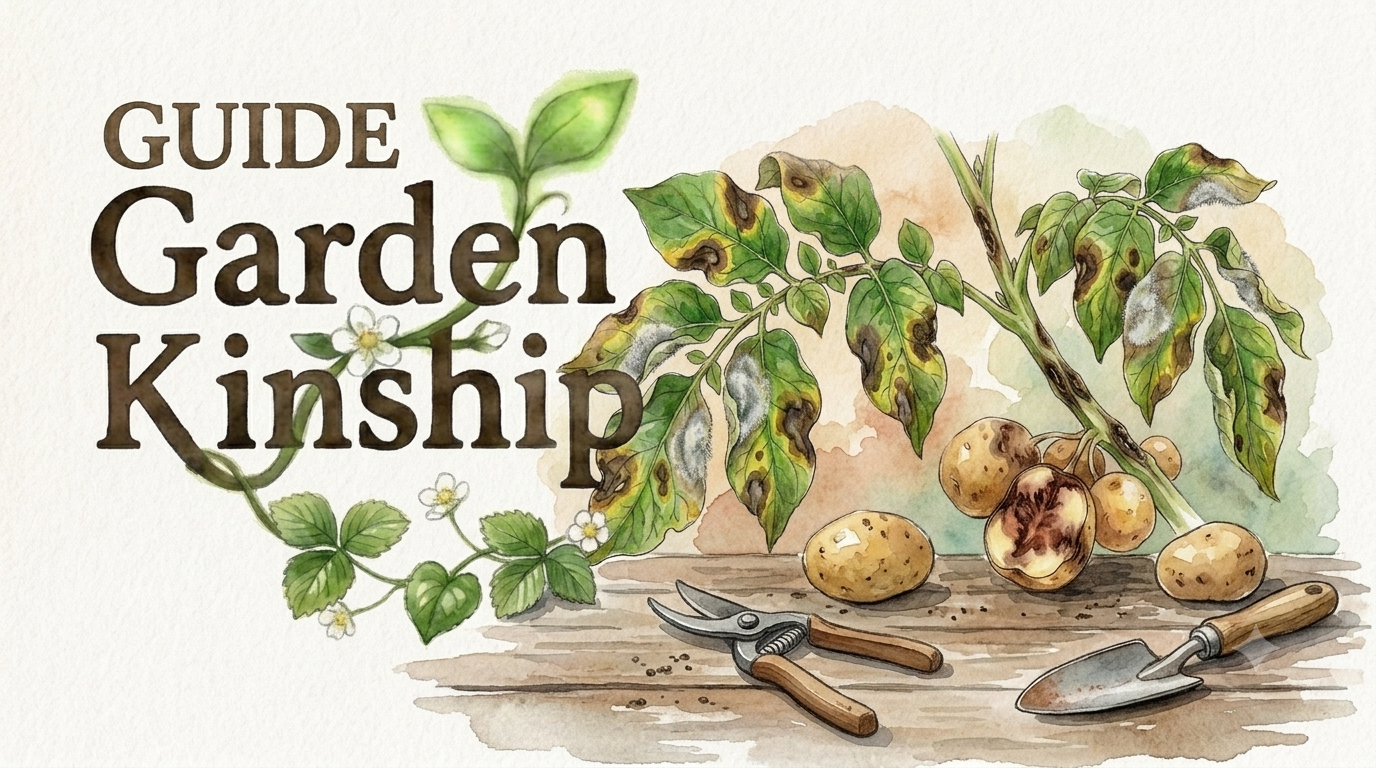
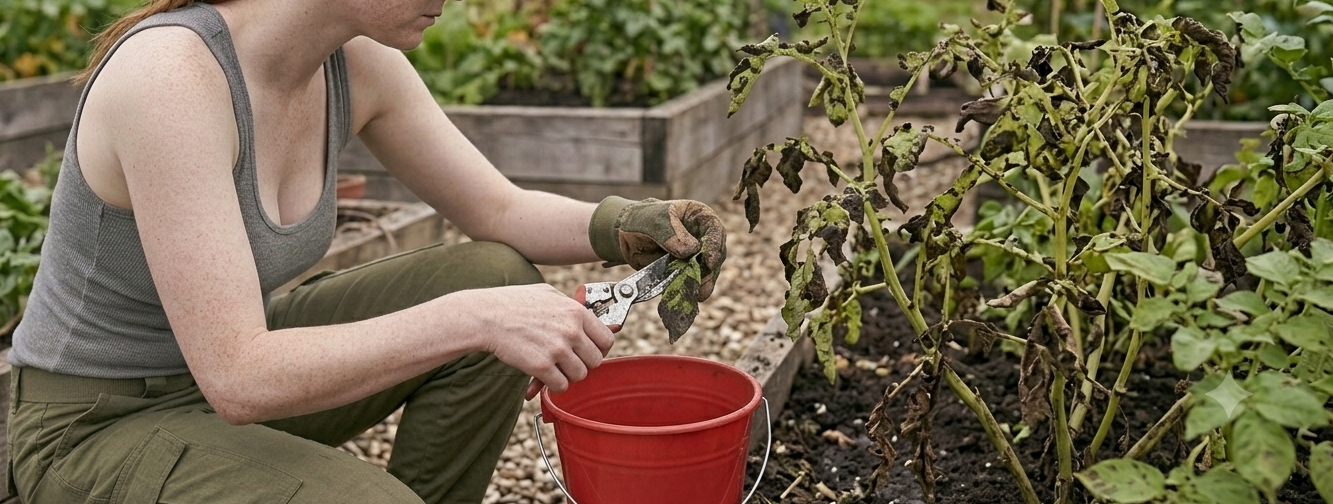
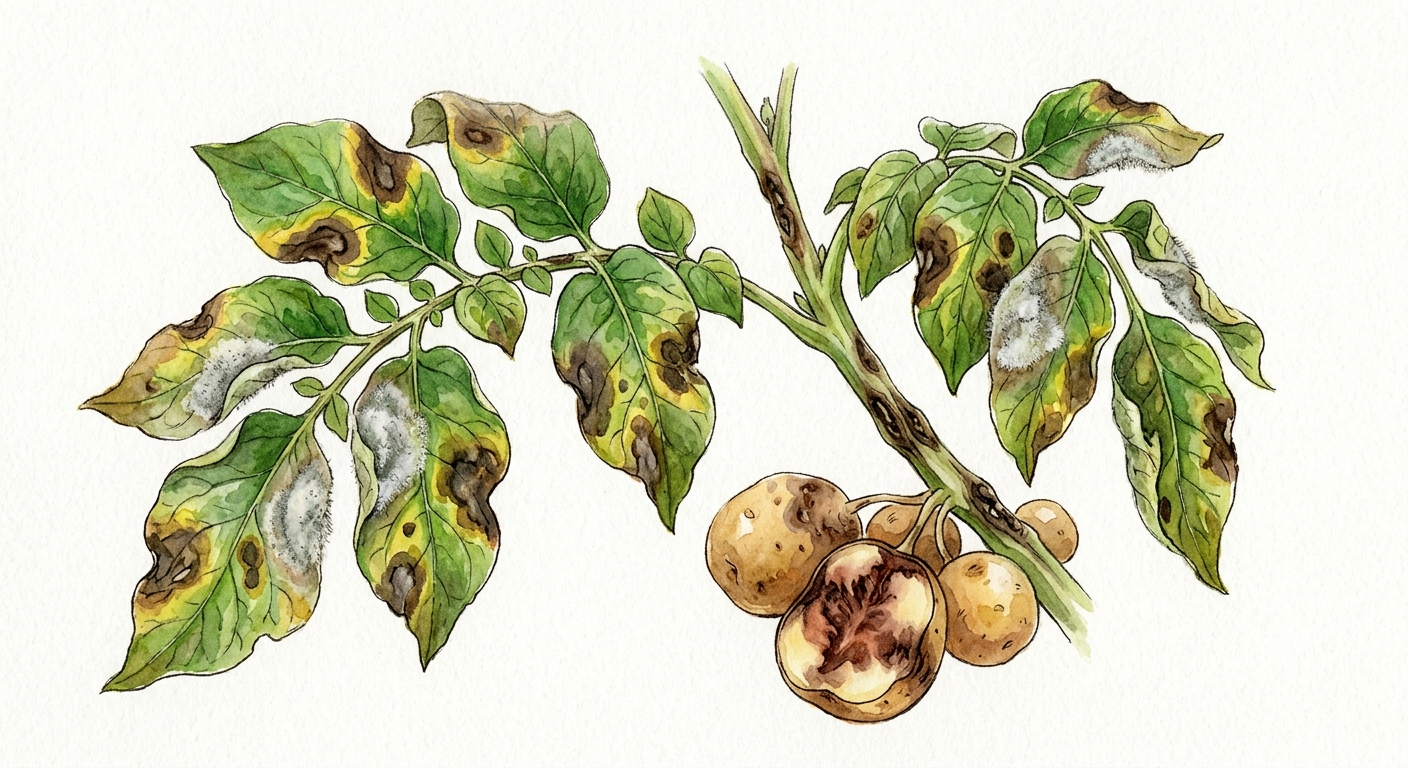
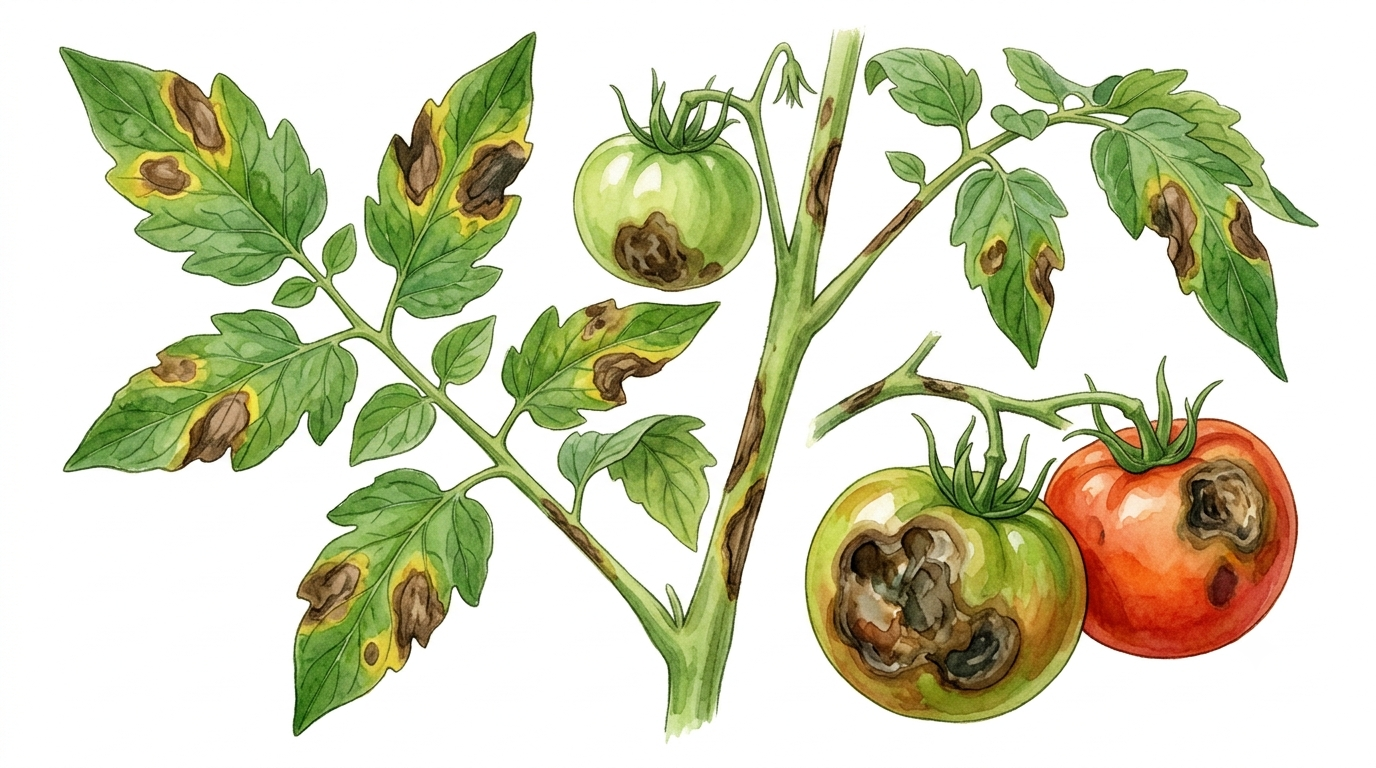
Late blight looks like this. Dark patches on the leaves that start at the margins or tips and look greasy or water-soaked rather than dry — that texture is the single most reliable tell. Around the dark area there's often a pale yellowish halo where the tissue is dying next. Turn the leaf over in humid weather and you may find a fine white fuzz at the edge of the lesion; that's the sporing stage. On stems you get dark brown-to-black lesions that girdle and collapse them. On fruit you get firm, brown, oddly marbled patches — not the soft wet rot of ordinary spoilage. And it moves, visibly, day to day.
Now the things it gets confused with:
Early blight (Alternaria solani) is a different organism with a different temperament. It shows on the oldest, lowest leaves first, as brown spots with concentric rings inside them like a tiny archery target, and it creeps upward over weeks. It's a nuisance rather than a catastrophe, and plants generally crop through it. The name is thoroughly misleading — it's not an early version of late blight, it's an unrelated disease.
Magnesium deficiency yellows the tissue between the leaf veins while the veins stay green, on older leaves, with no dark greasy patches at all. Extremely common in heavily fed tomatoes and completely harmless to your crop.
Leaf mould mostly turns up on greenhouse tomatoes: pale yellow blotches on the upper leaf surface with a velvety olive-brown growth directly beneath them. Bad for vigour, not a plant-killer.
Ordinary weather damage — scorch, wind, splash — makes dry, brittle, papery brown areas that don't spread and don't have that soaked look.
The honest summary: if the patches are dry, confined to old leaves, or holding still, you have time. If they're greasy, spreading toward the growing tip, and appearing on stems, you do not.
The day you see it: potatoes
Potatoes are the crop where prompt action genuinely rescues a harvest, because the part you eat is underground and the disease is above it. Your job is to sever the connection before spores wash down into the soil and into the tubers.
When roughly a quarter of the foliage is affected, or as soon as you see lesions on the stems, cut the haulms off at ground level and clear every scrap of the material away. Don't compost it. That single act stops the infection travelling downward.
Then — and this is the step people skip — wait about two weeks before you lift anything. Two things happen in that fortnight: the tuber skins harden enough to handle harvest, and spores sitting on the soil surface die off. Lift too soon and you drag your crop up through live spores. Lift in dry conditions if you possibly can.
Don't leave them in much longer than that either, or you're simply donating the crop to slugs. And treat anything from a blighted bed as an eating crop, not a storing crop: use them soon, and don't put them into a sack of sound potatoes, because one infected tuber will take the sack with it. If you grow potatoes, this whole sequence is worth knowing by heart before you need it.
The day you see it: tomatoes
Tomatoes are the harder conversation, because there's no underground reserve to protect. An outdoor tomato plant with established late blight is, in the great majority of cases, finished. You can remove affected leaves early on and buy a little time, but once stems are lesioned, the plant is going.
What you can still do is make sensible decisions about the fruit, and the guidance here is more precise than most people realise:
Unblemished fruit from an infected plant is safe to eat. Pick it and use it quickly — it's at elevated risk of developing lesions after harvest, so it isn't something to leave in a bowl for a week.
Don't can or preserve fruit showing any lesion, even a small one. You can't be confident the interior is clean, and tomatoes sit close enough to the acidity threshold that preserving compromised fruit is a genuinely poor idea. Cut-and-use-today is fine; jars are not.
Be sceptical about ripening green fruit indoors off a badly infected plant. This is the advice that gets handed out cheerfully and deserves a caveat: once foliage and stems are heavily hit, a lot of the fruit is already infected without showing it. Bring it in and much of it ripens into rot on the windowsill. Off a lightly affected plant, worth trying. Off a collapsing one, you're mostly relocating the problem to your kitchen.
Aubergines are in the same family and can be affected, though they're a good deal less prone to it than their relatives — if you're growing aubergine alongside tomatoes, keep an eye on it but don't lose sleep.
What actually reduces the risk next year
You can't stop spores arriving. Everything below is about narrowing the window in which they can do damage.
Keep the leaves dry. This is the big one, and it follows directly from the Hutton Criteria — the disease needs sustained leaf wetness to establish. Tomatoes under cover, in a greenhouse or even a simple rain shelter, are dramatically safer than tomatoes standing in the open getting rained on, and it's the single most effective change most gardeners can make. Water the soil, never the foliage, and water in the morning so anything splashed has the day to dry. And as with beans, don't work among the plants while they're wet — brushing down a soaked row is an efficient way to move spores from one plant to all of them. Space plants further apart than feels necessary; airflow is a disease control measure.
Use time as a defence. A crop that's finished before blight weather arrives can't catch it. Early potatoes lifted in June routinely dodge outbreaks that flatten maincrops in August, and fast tomatoes are worth real consideration in a cool, damp climate — Stupice and Glacier both crop notably early, and reliable croppers like Sungold and Gardener's Delight give you fruit in hand well before the risk peaks. If you're growing a long-season paste tomato like San Marzano outdoors in a wet region, you're asking it to stand in the danger zone for weeks longer than it needs to. Work the timings against your own season in the planner rather than a generic packet date.
Consider genuinely resistant varieties. Every tomato in this catalog lists late blight among its vulnerabilities, and that uniformity is the point rather than an oversight: the standard garden varieties, heirloom and modern alike, simply have no meaningful resistance to it. The varieties that do are a small and specific group. For potatoes, the Sarpo family — Sarpo Mira and Sarpo Axona — are the well-known blight-resistant options. For tomatoes, Crimson Crush and Mountain Magic were bred for it. None of them are in the catalog yet. If blight has beaten you two years running, those names are where to look, and no amount of good technique substitutes for them.
Don't be the source. Dig out every volunteer potato that comes up next spring, never compost blighted tubers or haulms, and don't leave a forgotten sack of potatoes sprouting in the shed. That's how the cycle closes, and it's the one link in the chain that's entirely under your control.
The short version
Watch for warm nights and long damp mornings from late July. Check leaf undersides every few days once that weather sets in. Learn the greasy, water-soaked texture — it's the tell that separates a catastrophe from a nuisance. If it's potatoes, cut the haulms and wait a fortnight. If it's outdoor tomatoes, save what fruit is clean and use it fast. And next season, keep the leaves dry and finish early, because those two things beat everything you can spray.
If you want the rest of the tomato year — sowing through to the last ripe fruit — I wrote about growing tomatoes in full. And the wet-foliage rule that shows up here turns up again in growing beans, for the same reason: water on leaves is how most plant disease travels.
— Pernille
About the author
Pernille has spent almost her entire adult life working in gardens, both personally in her own gardens, as well as professionally. She has worked at Arley Hall & Gardens, at Systrarna Lindskogs in the Swedish riviera of Österlen and spends most of her waking hours planning gardens, counting seeds and thinking 3 seasons ahead (at least). She is also the founder and creator of Garden Kinship.