

Ladybugs
Coccinellidae
The one predator here where the adults hunt as hard as the larvae do.

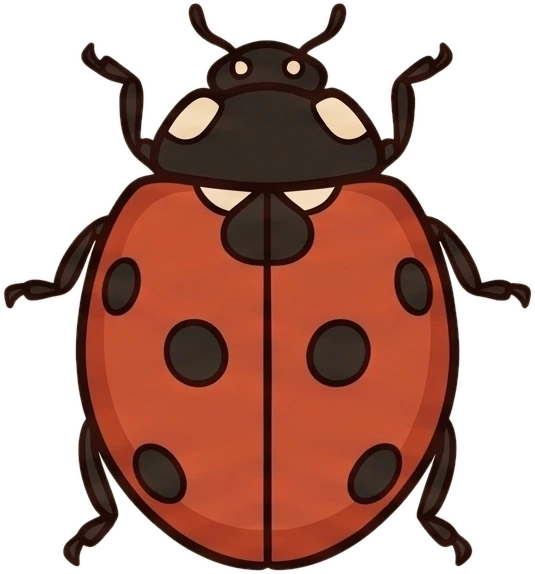
What they are and what they do

Unlike hoverflies and lacewings, both stages are predatory. Adults and larvae work through soft-bodied prey — aphids above all, plus leaf beetle larvae, mealybugs, psyllids and whiteflies.
How they feed changes as they grow. Young larvae pierce their prey and suck out the contents; older larvae and adults chew and can eat the insect whole. UC IPM records an adult convergent lady beetle consuming about 100 aphids a day before it moves on.
The larva is the stage gardeners kill by mistake. It looks nothing like the beetle: long-legged, elongated, and in UC IPM’s words resembling a tiny alligator — mostly black or dark grey, sometimes with orange or yellow markings. The eggs are yellow ovals about a millimetre long; the pupa is glued to a leaf and does not move.
Not every ladybird is an aphid hunter. Some feed on mildews, and a few feed on plants.
Pests they keep in check
- 537 plants in our catalog are prone to it
Plan a garden that feeds them
Drop these plants into a plan and see how the season lines up — the predators need their food and their cover in place before the pests arrive.
Plants that attract Ladybugs
53 plants in our catalog draw Ladybugs in. Grow a few of them near the crops you want protected.








How not to kill them
Avoid broad-spectrum, persistent insecticides and miticides — UC IPM names acaricides explicitly, because miticides aimed at spider mites take the beetles with them.
Learn the larva before you squash it. See the "tiny alligator" note above.
Control ants, which protect honeydew-producing aphids from predators and parasites.
Do not try to buy your way out of an outbreak. UC IPM found that retail lady beetles are unlikely to be present in sufficient numbers, and most of them disperse from the garden within a few days.
Getting them through the winter
As adults, sheltering together. The sevenspotted lady beetle overwinters mostly as adults in protected places, and the RHS notes that most ladybird adults overwinter in sheltered spots, often in large groups.
Where those groups sit varies, so leave a choice of shelter: some cluster under leaf litter, rocks and debris, while UC IPM records convergent lady beetles aggregating on low-growing vegetation in moist spots.
Across the season, plant a variety of species that flower at different times — the gap between one plant finishing and the next starting is when the adults leave.